Start with the room, not the ornament
A dramatic mineral specimen can dominate a hotel lobby while revealing almost nothing about the building’s former use. Begin instead with the dimensions, daylight and circulation of the room. Large windows might have supported close visual work, but they could equally belong to ordinary offices. A broad corridor could have accommodated collections, students or simply ceremonial movement. Physical observation produces questions; it does not settle them.
Compare a current plan with the earliest reliable plan you can find. Identify load-bearing walls, staircases, courtyards and later subdivisions. An original teaching room may now contain several bedrooms. Conversely, a room presented as a historic laboratory might have been assembled from smaller spaces during conversion. A date and a room label on an archival drawing are more persuasive than visual resemblance alone.
Read storage as a working system
Scientific collections require order. Shallow map drawers, compact specimen trays and tall glazed cabinets can help explain how that order was maintained. Look for numbering, label holders, adjustable fittings and evidence of repeated handling. These details may suggest a working system rather than a piece of decorative furniture, but the cabinet’s origin still needs documentation.
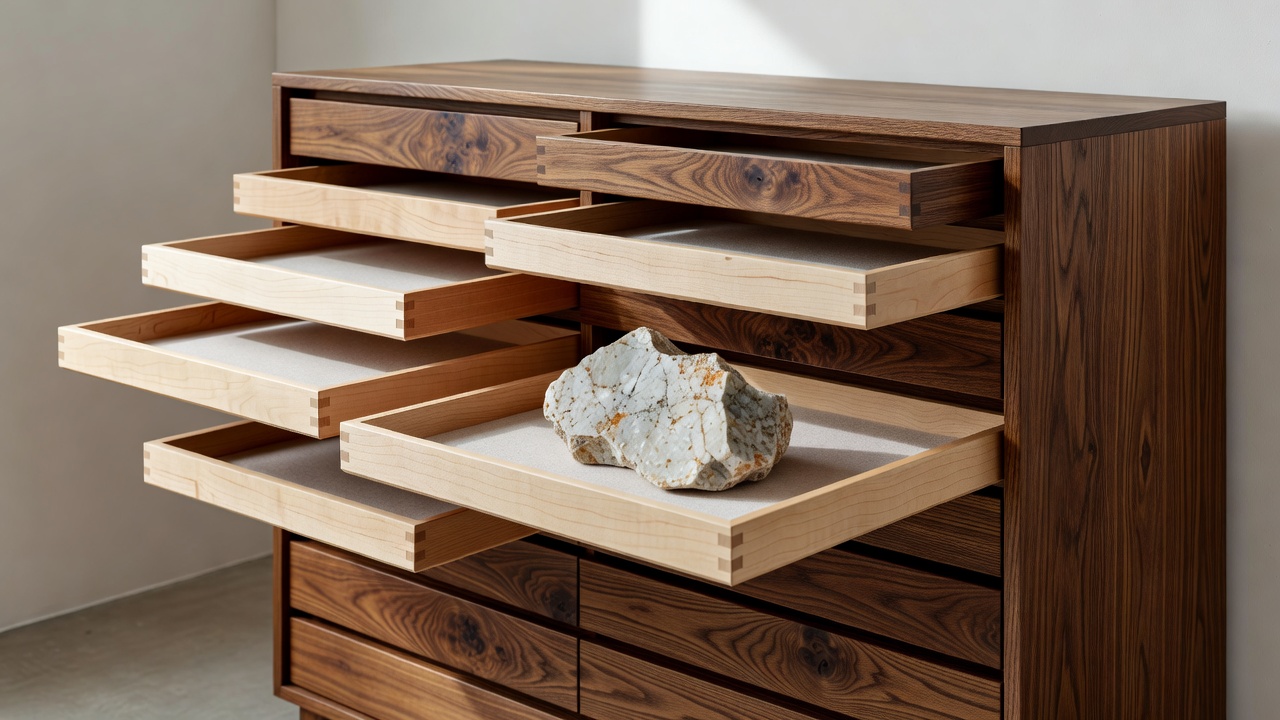
A cabinet can be authentic yet unrelated to the building. It may have been bought from a dealer, transferred from another institution or reconstructed using old components. Ask whether it appears in a dated interior photograph or inventory. Also ask whether its present position is original. A displaced object can still tell a worthwhile story, provided its movement is acknowledged.
Map drawers deserve the same care. Their width may correspond to a sheet format, but that alone does not identify a geological survey. Architects, engineers and cartographers used similar storage. The most useful interpretation connects the furniture to actual catalogued maps, institutional records or identifiable historic photographs.
Distinguish geological material from geological history
Marble, limestone and granite occur in buildings with no scientific past. A fossiliferous floor is evidence of a material, not proof of an institute. Even the word “marble” can describe a commercial stone category rather than a strict geological classification. Unless the material has been identified reliably, use a measured description: a polished pale stone, a veined surface or a fossil-bearing slab.
A geological interpretation can nevertheless enrich a stay. Ask where the stone was quarried, when it was installed and whether an original specification survives. The answers connect architecture to extraction, trade and craftsmanship. They should remain separate from claims about the occupants. A new lobby countertop can have a fascinating geological story without being inherited scientific fabric.
Avoid collecting fragments or testing surfaces. Do not scratch a stone to judge hardness, apply acid to identify carbonate or open a historic fitting without permission. In a heritage interior, respectful looking and an informed question are more appropriate than improvised field experiments.
Notice the less photogenic traces
Patched service penetrations, redundant doorways and changes in floor level can reveal adaptation more clearly than restored ornament. A former laboratory may have needed water, extraction or substantial work surfaces. However, a pipe route could also belong to later heating or domestic plumbing. Function should be established through plans, specifications or a professional survey rather than inferred from a single trace.
Historic England’s guidance on understanding historic buildings offers a useful model: describe what is visible, record its location and distinguish observation from interpretation. The Society for the Protection of Ancient Buildings encourages attention to the accumulated life of old fabric. Neither resource certifies a particular hotel’s claims. Their value here is methodological.
A three-part field note
- Observation
- What you can see, where it is and how it is attached.
- Interpretation
- The function you think it may have served, expressed provisionally.
- Corroboration
- The drawing, photograph, inventory or expert account needed to test that interpretation.
Allow good conservation to look new
Careful adaptation does not always preserve an untouched appearance. New services, discreet fire doors and repaired joinery may be essential to the building’s continued use. ICOMOS’s Venice Charter and Australia ICOMOS’s Burra Charter provide influential frameworks for thinking about significance and change, though they are not universal hotel approval schemes and do not replace local requirements.
Ask whether new work is documented and whether interpretation distinguishes original, repaired, relocated and newly made elements. A contemporary brass instrument displayed honestly as a reproduction is more informative than an unlabeled antique with an invented provenance. The best reading of a building recognizes several layers without forcing all of them into one heroic scientific moment.
Useful reference points
- Historic England — recording buildings and understanding significance.
- Society for the Protection of Ancient Buildings — care of historic fabric.
- ICOMOS — international conservation principles.
- Australia ICOMOS — the Burra Charter and associated guidance.